
article / ekne
Are you pricing for products or people?
How customer-centric, product-centric, hybrid, and personalized approaches shape data-driven pricing strategy.
Two companies can sell the same product and have the same costs, but one makes 30% more profit. The difference? How they set their prices. Pricing is the final touchpoint of your commercial strategy, the moment where all your marketing, segmentation, and advertising efforts are put to the test. Get it wrong and the effort is wasted; get it right and you create a win-win for your business and your customer.
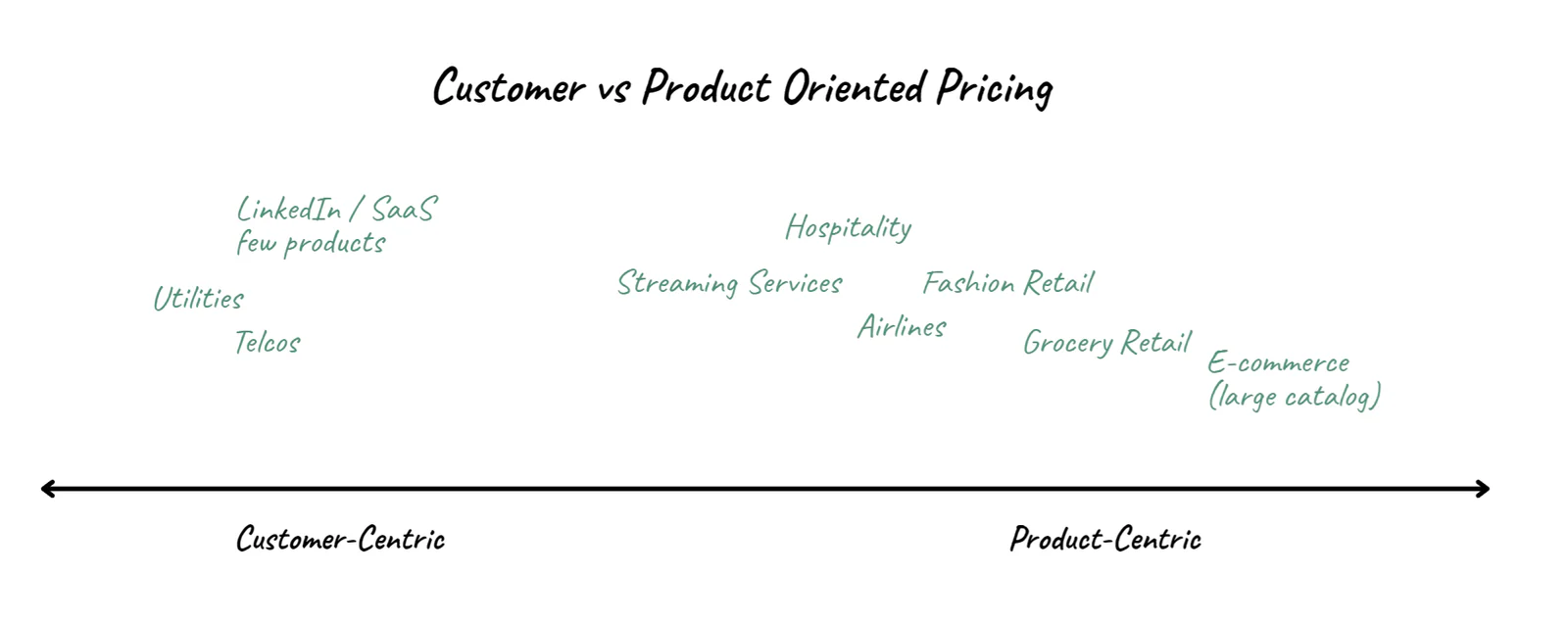
So how do you get pricing “right”? Increasingly, companies are turning to data-driven approaches. And in practice, these approaches often fall along a spectrum with two distinct poles: customer-centric pricing vs product-centric pricing.
Customer-Centric Pricing
In customer-centric pricing, the customer is at the heart of the equation. The goal is to understand each customer’s price sensitivity and willingness to pay, then use that insight to tailor offers or prices.
This approach is common in industries with relatively few products but very large customer bases, for example utilities, telcos, or online services like LinkedIn, which uses behavioural data to decide which tier, offer, or trial period to show to each user. The process often starts with purchase history, enriched with profile information such as demographics, usage, or engagement, to build models that predict individual elasticities.
Think of a telco offering 10 products to millions of customers — customer-centric pricing means figuring out which customer is willing to pay a premium for unlimited data, and which one will only upgrade if offered a short-term discount.
We do not need long purchase histories for everyone, and often we only have one or two observations for each customer, but by pooling transactions across a large customer base, we can model how different factors affect purchase likelihood. Using the prices and purchasing events as the response variable, you estimate demand curves using regression or classification models (these models model the probability of a buy/churn event and are then translated back into elasticities), then simulate different price or discount options to find the one that maximizes profit, revenue, or other goals. This can be done in batch (e.g., setting quarterly prices) or dynamically in real time.
While this method shines when there are limited products, the opposite challenge arises in industries with thousands of products, where the focus shifts from tailoring prices for people to optimising prices for the products themselves.
The Product-Centric Approach to Pricing
If you sell thousands of products, pricing each one individually is impossible without data. Product-centric pricing starts with the products, and is common in retail, grocery, and other industries with large SKU counts. The aim is to understand how price changes affect sales and use that insight to set prices and plan promotions. Below, I give a high-level view of how to identify price elasticities, map product relationships, and use this to inform an effective promotion calendar.
How Your Sales History Reveals Price Sensitivity
The first step is to work out how sensitive each product’s sales are to changes in its own price — its own-price elasticity. This can be estimated from transaction history by looking at how sales vary at different price points over time. When some products don’t have enough price variation to give a stable estimate, we can “borrow strength” from similar items in the same category, pooling the data so that all products get a sensible baseline elasticity. Hierarchical Bayesian models are a subset of models well suited for this task. Sometimes we often also need to group similar items together to get enough observations for statistically significant results.
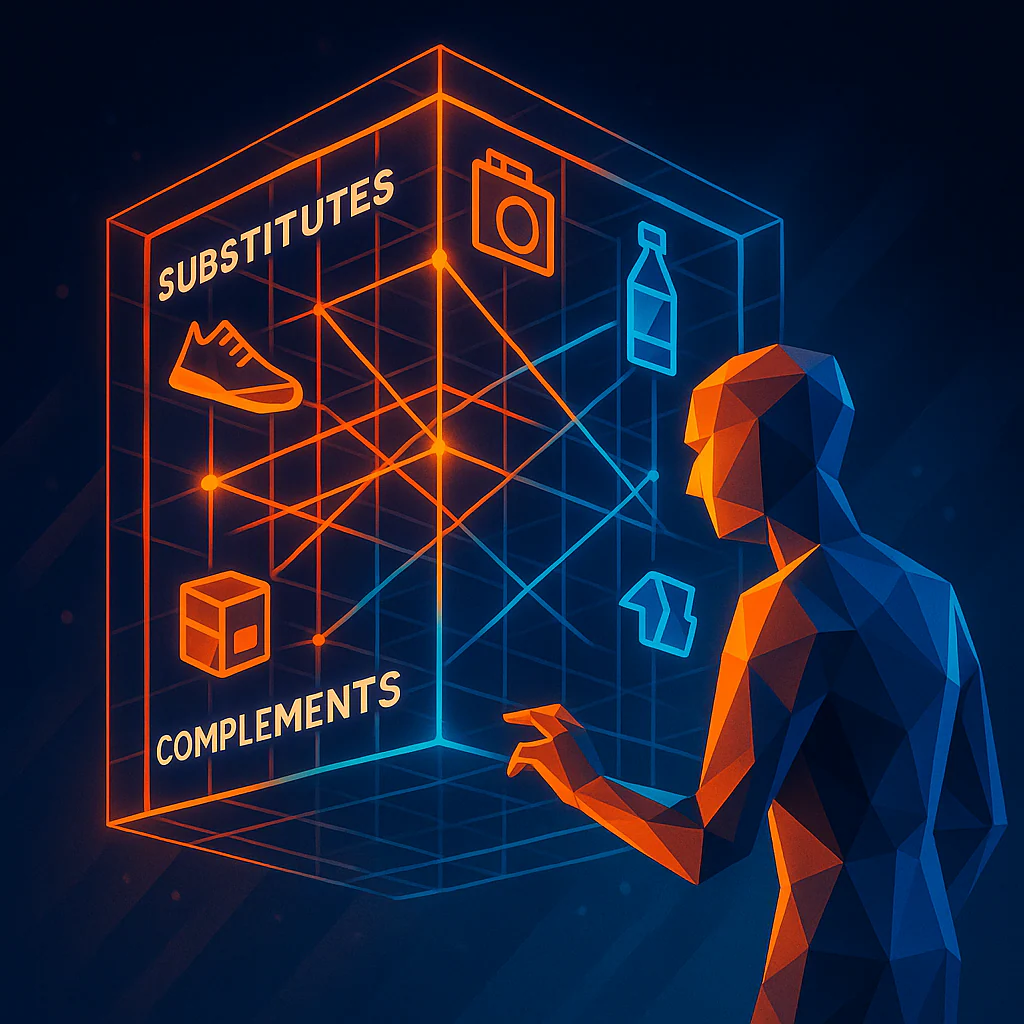
Once we have each product’s own-price elasticity, the next step is to see how changes in one product’s price affect demand for others — the cross-price elasticities. This is where we find the substitutes and complements: does putting Romaine lettuce on sale steal volume from Iceberg or does it boost tomato sales because people make more salads? The result is a cross-elasticity matrix, with own-price effects on the diagonal and cross-effects off-diagonal.
Building a Data-Driven Discount Calendar
Using the cross-elasticity matrix, we can forecast the uplift and profit impact of any potential promotion, not just for the promoted item but also simultaneously for the rest of the portfolio. We can define realistic promotion “options” for each SKU — e.g. a modest discount, a deep discount, a multi-buy — and attach estimated sales lifts and margin impacts to each, based on the elasticities. These options, along with business constraints (limited promo slots, endcap space, budget caps, category rules, seasonality), feed into an optimisation model.
Using an optimisation model such as a mixed-integer optimiser allows us to search across all possible combinations of SKU–week–promotion choices to find the promotion calendar that maximizes profit (or revenue, or traffic), while respecting the constraints. Because the optimiser “knows” about both own- and cross-effects, it avoids wasteful combinations (like discounting two near-identical items in the same week) and finds combinations that lift total basket spend. The result is a data-driven calendar that is optimal given both the elasticity model and the real-world limits the business operates under.
Hybrid Approaches: Blending Customer and Product Views
Of course, the world is not black and white, and most businesses do not sit neatly at one end of the customer-product spectrum. In practice, many combine elements of both customer and product-centric pricing — using product-level analysis to set the structure, and customer-level insights to fine-tune execution.
For example, in SaaS or telco with a small portfolio, product-centric pricing means optimising the product options themselves: plan prices, bundles, and their trade-offs. Then, customer-centric tactics personalise who gets which offer (trial length, intro discount, renewal save-offer). In other words: set a strong rate card at the product level, then tailor the offer at the customer level.
Another example would be in B2B energy and utilities where the product-centric element might be setting standard tariff structures, peak/off-peak rates, and contract menus based on cost and market factors. The customer-centric element comes in when tailoring offers for specific clients, adjusting terms for a factory with predictable base load versus a retailer with volatile demand, offering green energy bundles to sustainability-focused accounts or tweaking the price based on our knowledge of competitors in the bidding process. Like in the SaaS example, design the market-facing options at the product level, then use customer data to customise the deal. This is also where personalisation becomes a powerful lever, taking a well-structured product offer and tailoring it to the right customer at the right time.
The Twist: Personalisation Adds another Dimension
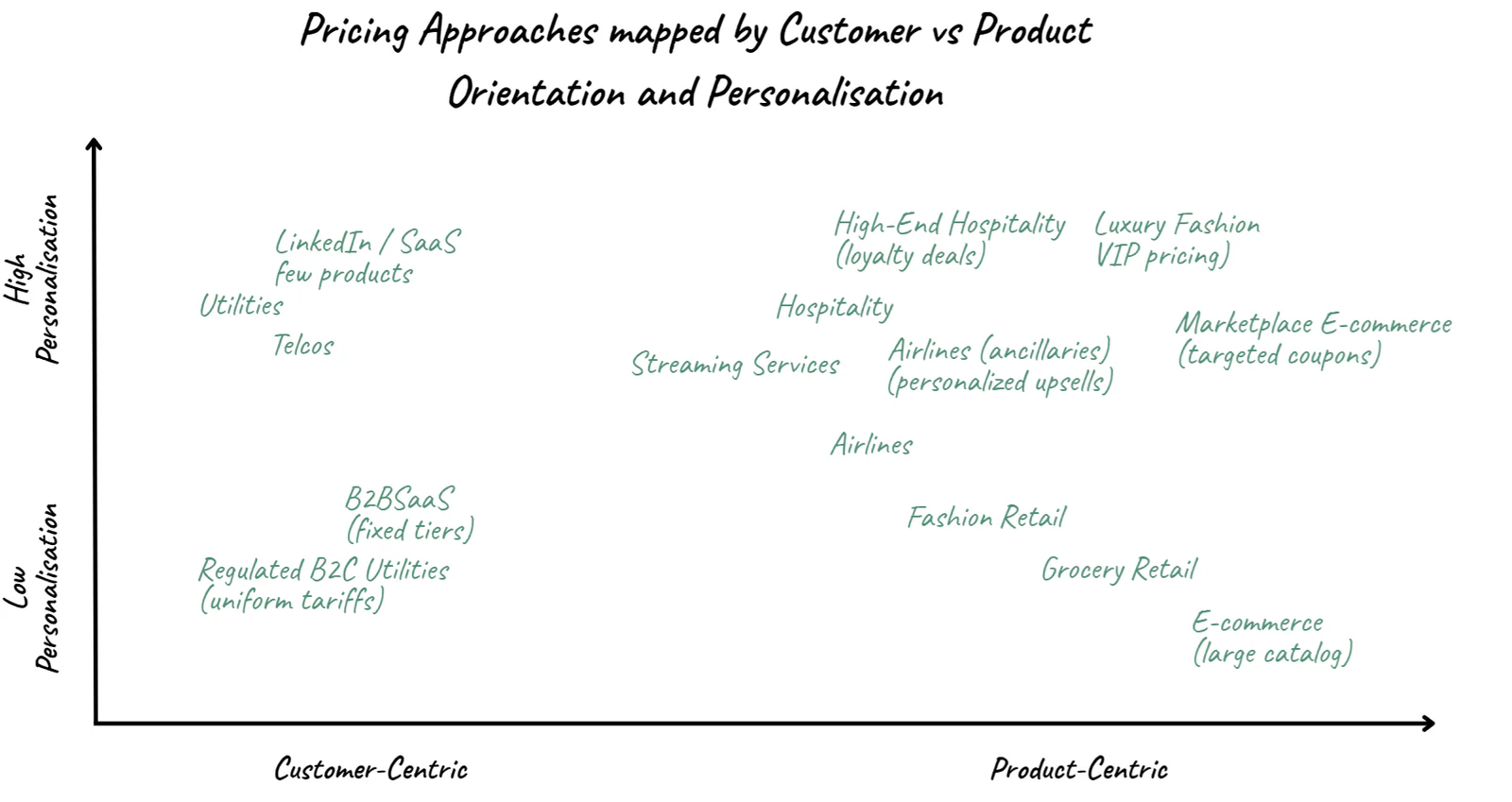
So far, we have looked at the spectrum between customer-centric and product-centric pricing. But there is another layer worth considering: the degree of personalisation. This measures how much the price or offer is tailored to the individual, versus being the same for everyone.
Some industries are obvious fits: airlines, hotels, and digital advertising are masters of personalising offers. But counterexamples show the picture is not so clean. Some highly customer-centric industries, like regulated utilities, have very low degrees of personalisation. (Although that doesn’t mean they cannot benefit from optimal pricing across their product ranges.) And some traditionally product-centric industries, like luxury fashion or marketplaces, are introducing targeted deals and loyalty perks that edge them toward the “personalised” side.
In a traditional mass market industry such as grocery retail, personalisation has already been around for years in some geographies. For example in UK supermarkets, the top players have long sent vouchers for items shoppers regularly buy. What’s changing is the sophistication and reach of these tactics. Instead of just discounting the same products you’ve bought before, retailers can now predict what might trigger your next visit — say, a personal coupon for a new craft beer similar to your usual brand — and deliver it through an app or loyalty card system. Done well, this doesn’t just increase sales of that item; it can lift the entire basket because once the shopper is in the store, they buy more.
Why is personalisation especially interesting now?
- Tech costs have dropped
- We can use AI to make personalisation feel truly personal
- Loyalty data collection is easier than ever before
- Integration into everyday channels like email, apps and social media
- Customer experience shifts (Customers are expecting more as everything is becoming more personal)
Personalisation is no longer tied to being “customer-centric” in the traditional sense. Even the most SKU-driven businesses can incorporate personalised levers to drive incremental value.
Factoring in the Competition
Like all strategy, pricing does not happen in a vacuum and apart from just considering how your own customers have historically reacted to your prices, it is also critical to consider the competitors.
Competitor prices influence customer expectations, perceived value, and ultimately the elasticity of your own products. In some industries, competitor monitoring is almost real-time, for example e-commerce, where price-matching and undercutting algorithms run constantly. In others, competitor prices change less frequently but still shape the “reference price” in customers’ minds.
Integrating competitor pricing into your models can be as simple as including competitor price indices in your regression models, or as sophisticated as simulating “game theory” scenarios where you anticipate and model competitor reactions to your own price moves. The importance varies by industry — telcos may change prices rarely, but airlines can update fares multiple times a day — so the level of integration should match your competitive environment.
The way forward
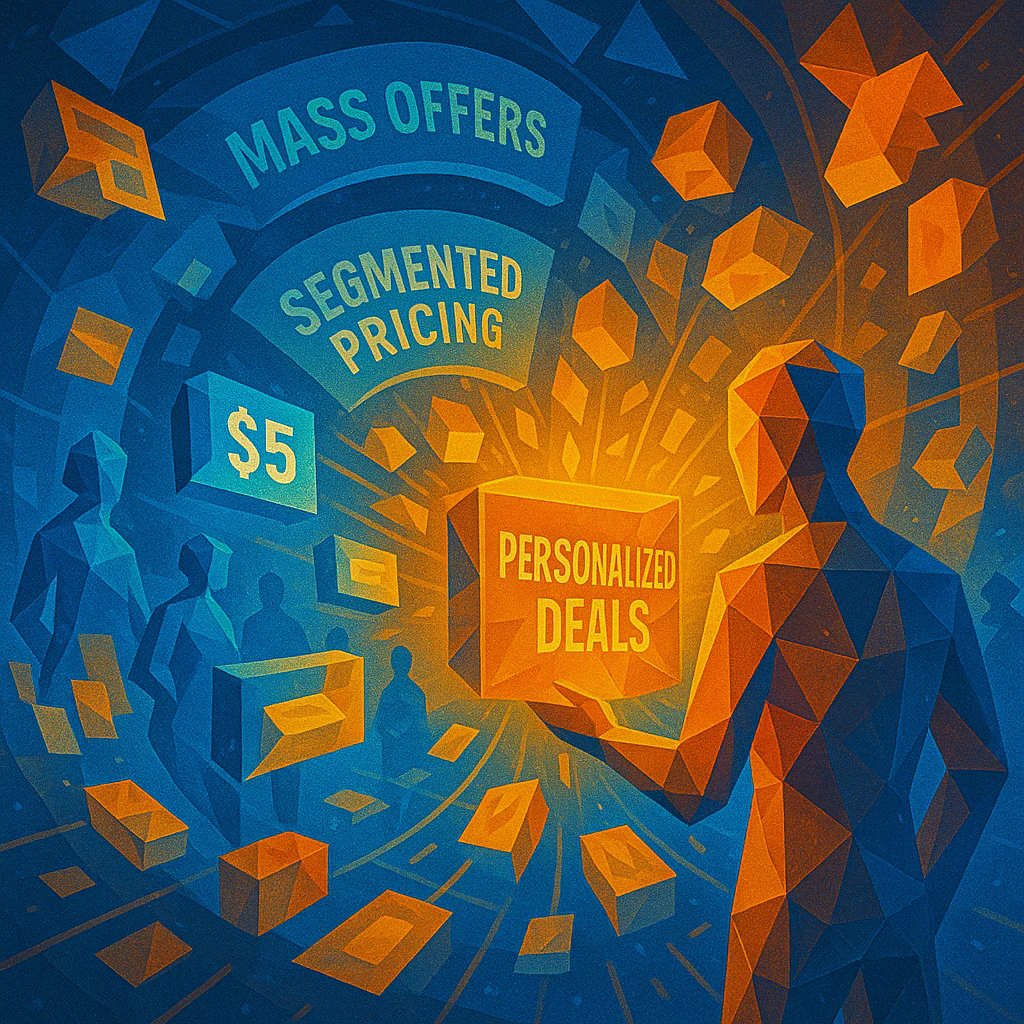
Data-driven pricing is not just for the big players with endless resources — it’s a practical advantage any business can use. Whether you lean toward customer-centric models, product-centric analysis, or a blend of the two, the real results come from combining price elasticity insights, cross-product effects, and the right level of personalisation for your market. Done well, it means pricing that works better for your customers and your bottom line.
Get in touch to continue the conversation on how data-driven pricing can unlock new value in your business.
Originally published on Medium on 26 August 2025. This archival edition preserves the original argument and illustrations in their historical context. View the original publication.