
article / ekne
Pricing-as-a-Service
A practical model for turning pricing from a one-off project into an always-on operating capability.

What if your prices were always on-strategy, always current, and you didn’t have to run a pricing project every quarter to get there? Pricing-as-a-Service (PaaS) turns pricing from an episodic effort into a reliable ongoing capability.
Think of pricing like a football team. You assemble the squad, assign positions, and set a game plan, that’s the initial project. But as the season unfolds, you adjust the lineup and tactics to the competition. Pricing is the same: to stay effective and current, you need a continuous pricing function.
For years, only the biggest firms could afford advanced pricing, data-driven models, experimentation platforms, and change-management consulting. My mission is to democratise pricing: to make rigorous, data-driven price setting available to far more businesses.
For a lot of companies, the best way to achieve that is through a managed service: a centrally run pricing hub that consumes relevant customer and purchasing data and continuously delivers optimal prices, discounts, and promotions, not as a one-off, but as an always-on capability.
Why Now: The Case for Pricing-as-a-Service
Over the years, I’ve built quite a few data-driven pricing engines. While these projects usually achieve their initial goals, clients often find it difficult to capture lasting value from the models. Running them in production tends to be more complex than expected, and day-to-day operations can be too technical for the team. In my experience, there are four main reasons why maintaining your own pricing infrastructure is so challenging:
- People turnover and capacity. When key resources leave, core competencies tied to the model are lost. Even when a new person is appointed, she or he must split time between value‑creating work and keeping the engine and data flows running — maintenance that steals focus.
- Data drift and breakage. Upstream data changes. New values appear that weren’t in the training data. Labels on categorical fields get renamed. I’ve even seen data warehouses overwrite historical product names, effectively erasing customer history. The model keeps receiving data, but it now needs re‑interpretation and relabeling to stay on track.
- DevOps complexity. Even “simple” models need reliable pipelines, monitoring, and cost‑efficient infrastructure. It gets trickier when multiple in‑house and external data sources feed ensemble models that should auto‑retrain and hit a clear SLA.
- Model Complexity. Even though we try to follow the principle of Occam’s Razor and strive not to develop models more complex than they need to be, the pricing optimization still requires a minimum level of complexity and technical pricing skills which can sometimes be difficult for a company to attract or retain.
PaaS addresses these pain points by providing a steady operating backbone while you focus on commercial outcomes. We handle the complexity of DevOps and price modelling, along with dealing with and alerting your team of inconsistencies in the data. If the case for PaaS resonates, the next question is control: what do you keep vs. outsource?
You Set the Why and We Run the How
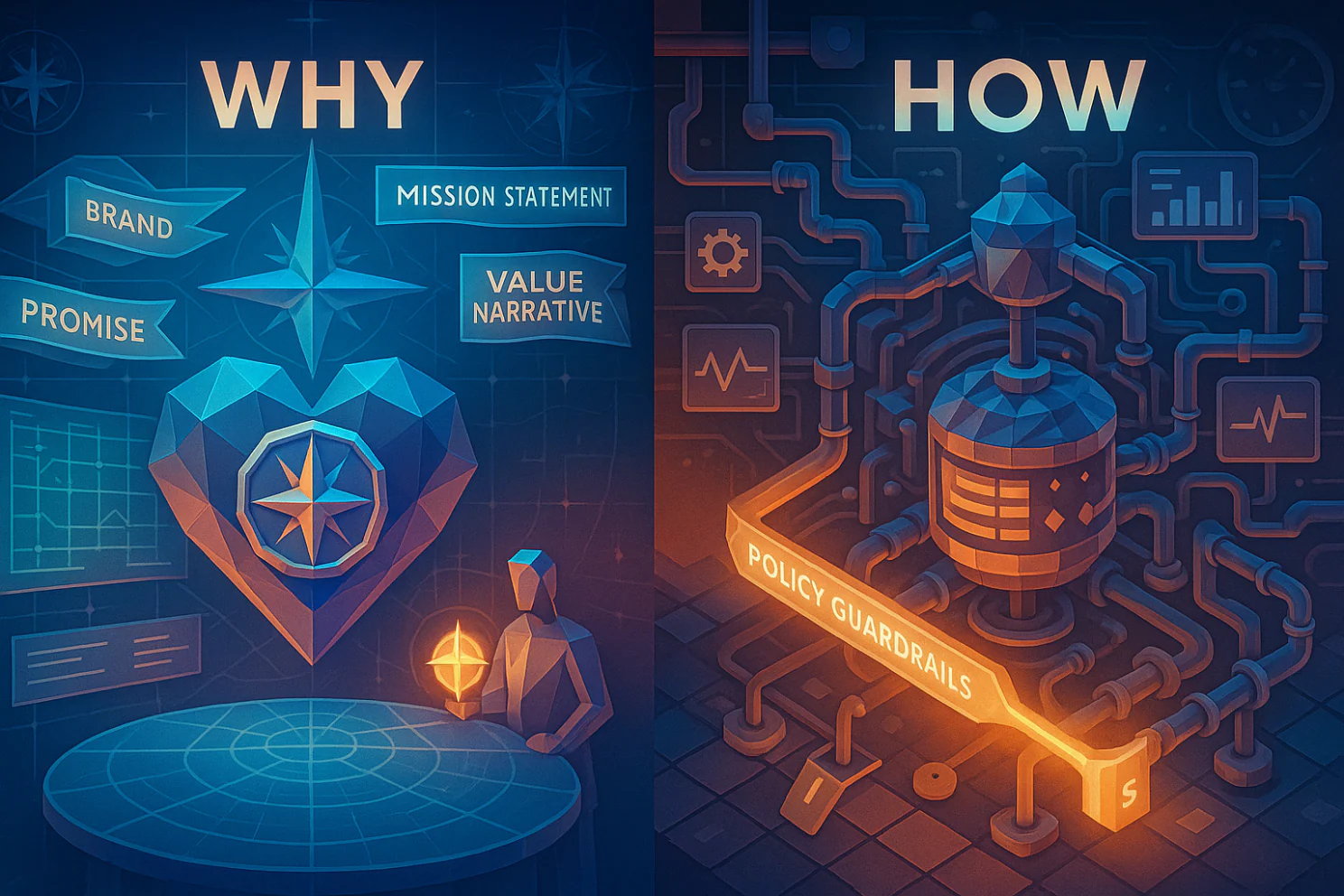
Some parts of the pricing process shouldn’t be outsourced, especially overall pricing strategy, which is a core part of company strategy. Strategy speaks to the heart and soul of the company: your positioning, value narrative, and where you want to compete.
Once strategy is set, execution becomes an operating function. Outsourcing that execution is as natural as outsourcing parts of IT, sales development, or fulfilment and logistics. Day‑to‑day pricing is something you must do well, but you don’t have to do it all yourself.
- Keep in‑house: Pricing strategy — market positioning, value narrative, brand promise, and where you want to compete.
- Outsource: Price execution and operations — elasticity estimation, list/pack architecture, discount ladders, tender guardrails, promo governance, experimentation, monitoring, and change controls.
With roles clear, here’s how the service actually runs day to day.
The ins-and-outs of PaaS (how it works)
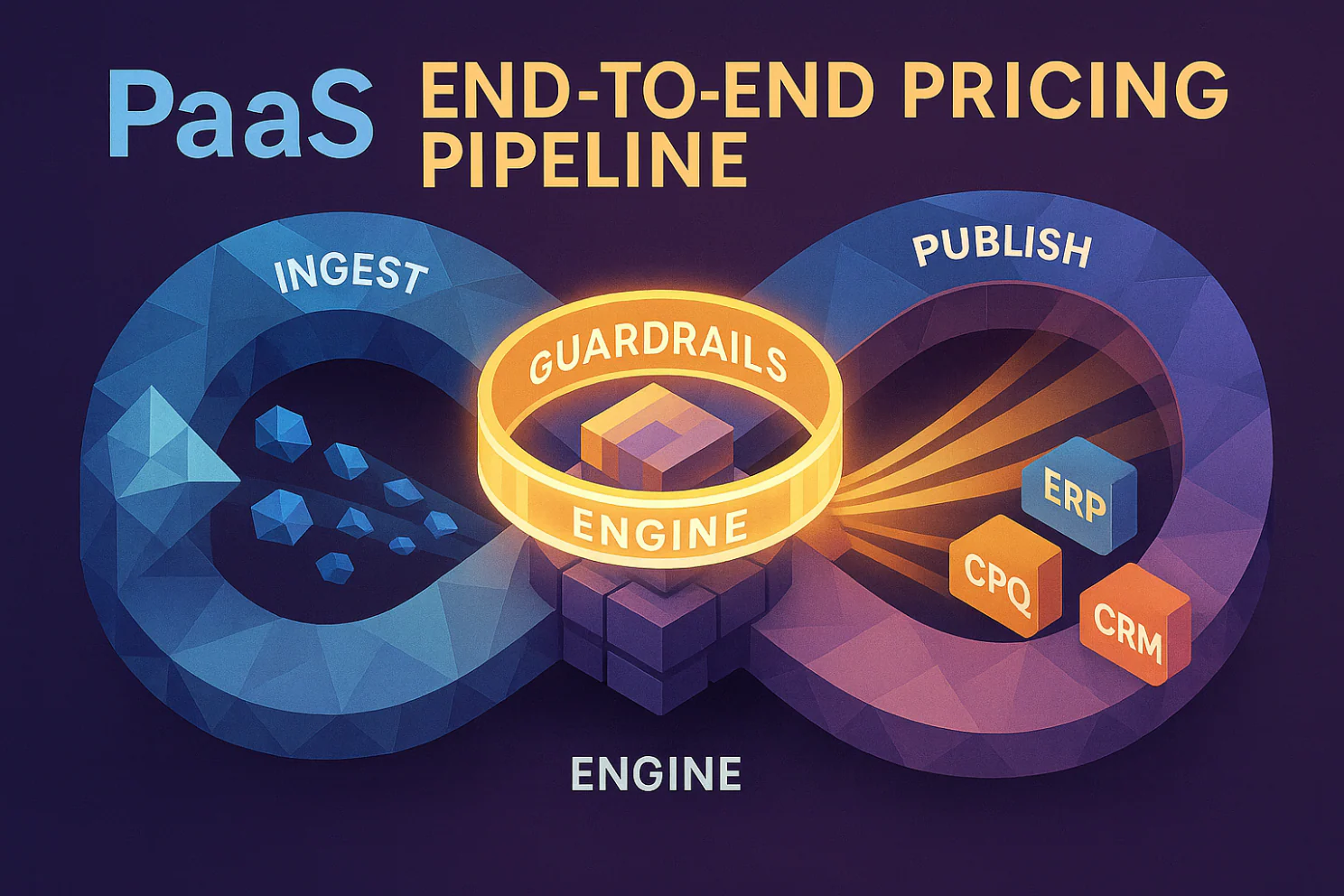
In practice, a PaaS solution ingests a defined set of inputs, applies business guardrails and configurable settings, runs them through a modular pricing engine, and pushes the resulting prices and recommendations back into the sales and marketing channels where decisions are made. The workflow also measures performance and learns, so the next round is smarter.
Inputs
A typical PaaS setup pulls from transaction history; product hierarchy and pack structure; cost files or indices; CRM activity and churn/win signals; promotion history; inventory or capacity; competitor benchmarks; and policy constraints. In less‑mature environments (e.g., start‑ups or early scale‑ups) those inputs can be sparse; the system starts with stronger priors, expert rules, external benchmarks, and simple demand assumptions, and then quickly adjusts the journey (tests, tags, feedback) to build the data needed for modelling.
The engine
Specialised modules work together: elasticity models estimate demand response; willingness‑to‑pay segmentation separates value seekers from premium buyers; price/pack architecture aligns offers and price points; discount ladders and tender corridors codify deal‑making boundaries; promotion simulators forecast uplift and cannibalisation; and anomaly detection flags outliers or leakage. Each module is governed by parameters you can tune without rewriting code.
Outputs
The engine produces operational artefacts the business can use immediately: price lists and rate cards by region, tier, or segment; personalised save/win‑back offers for at‑risk or high‑potential customers; tender “blue sheets” with target, stretch, and walk‑away logic; promotion calendars with pre‑ and post‑analysis; plus exception logs and approval prompts where human judgement is required.
Governance and control
Guardrails such as floors, ceilings, and exposure limits, ensure prices stay within strategic bounds. An approval matrix routes exceptions to the right level; audit trails preserve who changed what and when. A compact KPI set tracks impact and adoption: price realisation, margin %, churn/win‑rate, promo ROI, and contribution per customer. These metrics feed back into the engine to recalibrate elasticities, refine segments, and tighten guardrails over time.
The operating rhythm
Day to day, PaaS runs a simple cycle: ingest → decide → approve → deliver → learn. New data lands, the engine generates recommendations, exceptions are reviewed, prices are published to channels (ERP, CPQ, e‑commerce, CRM), and performance is measured to inform the next iteration. This cadence turns pricing from one‑off projects into a repeatable capability.
Is PaaS Right for You?
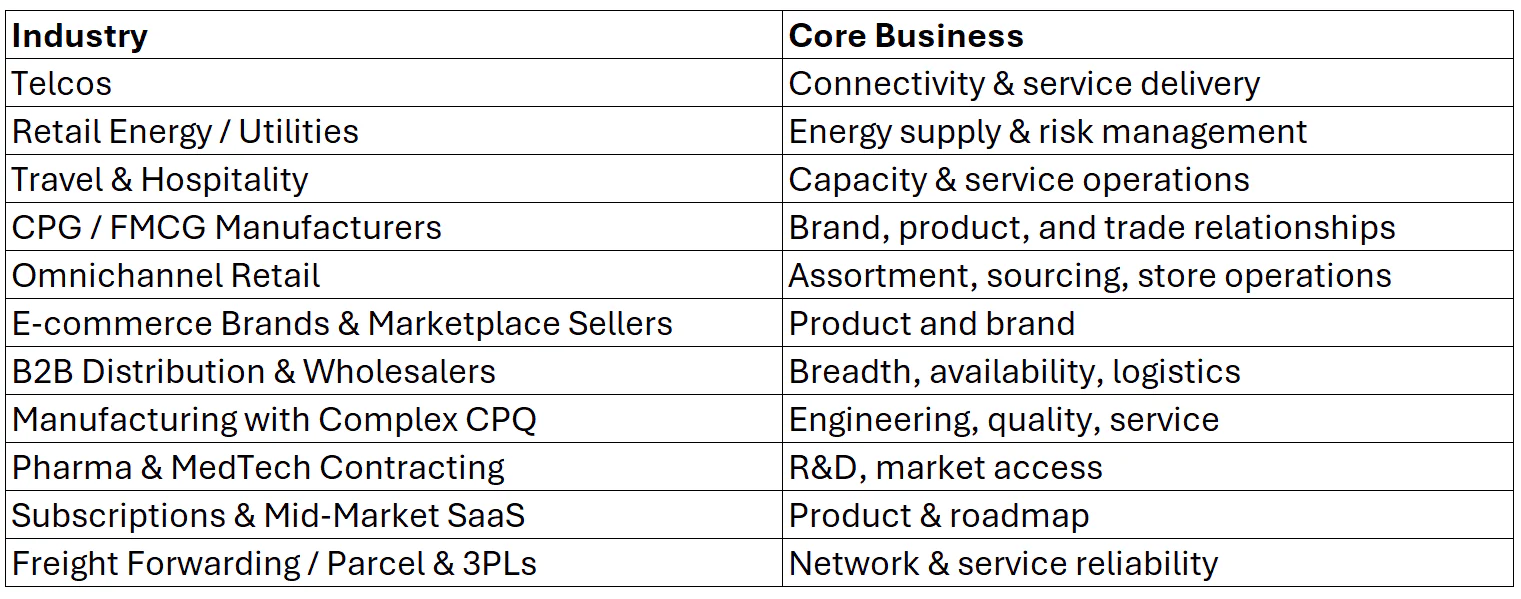
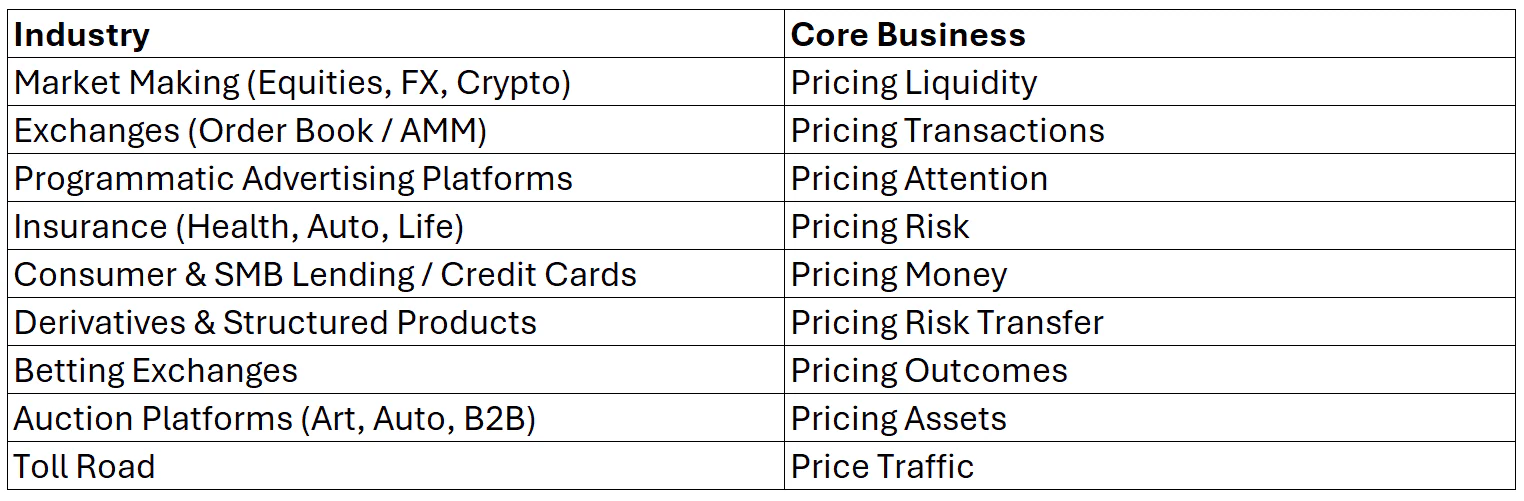
A useful rule of thumb: if revenue, risk, and customer value are determined by your live clearing/quoting engine, you can buy tools, but you shouldn’t outsource the execution. If other elements make up your core business, outsourcing pricing can be a great fit.
PaaS is generally a great fit if you:
- Sell subscriptions or repeat purchases where price realization, churn/win‑rate, and promo ROI matter.
- Manage many SKUs/customers/regions where price discipline and guardrails are hard to maintain manually.
- Have frequent cost changes and need indexation or pass‑through discipline.
- Want faster learning via controlled tests, not anecdote‑driven debates.
- Want to scale quickly and leanly without hiring a full CRO or Pricing Manager.
Examples of sectors where this applies:
PaaS is not a fit if you:
- Compete in markets where pricing is the product.
- Run a minimal assortment where pricing is simple and differentiation is elsewhere.
- Cannot share even minimally necessary data (we can work with anonymization and minimization, but zero data means zero lift).
Examples of sectors where outsourcing pricing is a bad idea:
Your 90-Day Onramp to Always-On Pricing
So let’s say your industry is a good match for pricing as a service, what would an implementation look like? Below I outline a standard 30/60/90-day high-level plan to showcase the steps needed to reach a fully operational PaaS solution.
Days 0–30: Baseline & Controls
We start by agreeing the big picture: what you want your prices to achieve, the guardrails you’re comfortable with (floors, ceilings, and approval rules), and how we’ll measure success. In parallel, we do a light data handshake to confirm what’s available and how often it can refresh. Then we build your baseline: price realization, a margin waterfall, win-rate/churn, and a short list of “high-leverage” moves to test first (for example, disciplined indexation, a cleaner discount ladder, or targeted save-offers).
To make this initial process be repeatable and more reliable we use an established method for analyzing how customer and product centric the industry is, as well the degree of personalisation you can can offer on the pricing side. Read more about that here.
Days 31–60: Pilot & Prove
Next we run small, controlled pilots on selected segments/SKUs/regions. Each pilot includes a comparison group (“holdout”) so we can show impact with real numbers, not opinions. We stand up simple live dashboards so your team can see uplift as it happens (e.g., margin points, win-rate changes, promo ROI), and we document how exceptions will be handled and who approves what (your SLAs).
Days 61–90: Scale & Embed
With evidence in hand, we roll out price lists/rate cards, automate the data refresh (API or secure file drops), and set up a monthly price council with clear inputs, decisions, and outputs. We finalize the governance pack (who can change what, and when) and align on the KPIs we’ll report each month.
Right-sized, not one-size
Does goes getting started with PaaS always take 90 days? No. We tailor scope and investment to your maturity. I’ve done pricing projects that took less than a month and others that stretched closer to half a year. Implementation speed largely depends on the complexity of the business, the number of stakeholders and the organizational willingness to implement.
Early-stage teams like startups or scale-ups might start with a lightweight data hookup and weekly price lists; mature enterprises may want multi-market rate cards, APIs into ERP/CRM, and formal approval workflows. Same path, different load: we scale the depth of analysis, the level of automation, and the governance to fit where you are today.
Ready to See It in Your Numbers?
Pricing is too important to be ad‑hoc and too operational to consume your leadership time every month. Keep the strategy where it belongs — with you. Let a service run the machinery so your prices are always on‑strategy, always current, and always earning their keep.
Curious about PaaS for your business (or a portfolio company)? Get in touch for a 30-minute fit check.
Originally published on Medium on 8 November 2025. This archival edition preserves the original argument and illustrations in their historical context. View the original publication.